Solving The Mystery Of The Strange Readings Recorded By The Voyager 2 Spacecraft On Uranus In 1986
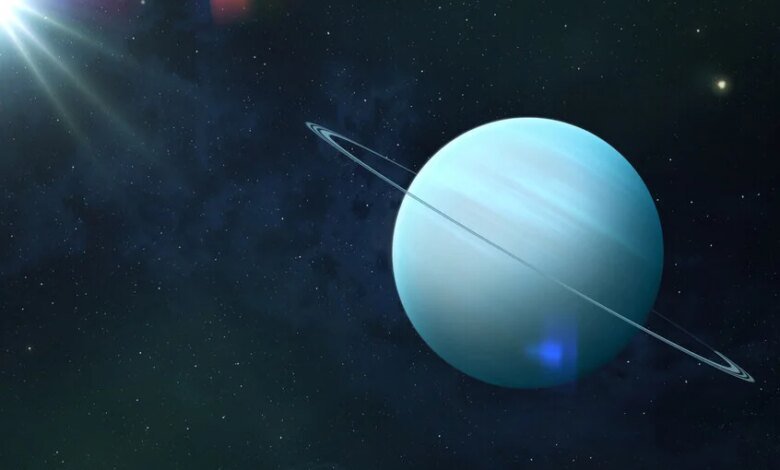



Research conducted by scientists from the Southwest Research Institute showed that Uranus was experiencing a very bad space weather day when the American probe visited it. The “off-the-charts” levels of the electron radiation belt surrounding the planet were actually the product of a strong solar wind storm, and not a reflection of its natural state.
“Uranus has a unique and dynamic magnetism, but our understanding has been limited for 39 years by just one ill-timed visit by Voyager 2,” said Robert Allen, lead author of the study.
Scientists explained that the probe arrived at Uranus at a rare moment when the planet was experiencing a violent solar storm, which completely distorted the radiation readings and made them appear exceptional. This misinterpretation made the scientific community believe for decades that Uranus had a unique radiation environment unparalleled in the solar system.
The research team was able to solve this puzzle by comparing Voyager 2 data with a major solar event that occurred on Earth in 2019, when a massive solar storm caused similar mutations in Earth’s radiation belts.
“When we put the data side by side, the similarities were striking,” said co-researcher Sarah Vines. “The same mechanism we saw on Earth in 2019 is what happened to Uranus in 1986.”
This discovery underscores the importance of re-examining old data with modern analysis tools. As Allen noted: “Science has come a long way since Voyager 2. What was mysterious four decades ago is now understandable.”
Although this mystery has been solved, the study opens the door to larger questions: If this error occurred in reading the radiation of Uranus, what other errors might have crept into our understanding of this mysterious planet?
Uranus remains one of the least understood planets in our solar system, and no spacecraft has visited it since Voyager 2. Scientists are now calling for a new mission dedicated to studying this ice giant, which may hide important secrets about planetary formation and evolution.
This discovery also highlights the importance of understanding the impact of solar activity on all planets of the solar system, not just Earth, especially with the Sun currently entering an active phase of its 11-year cycle.
Source: Gizmodo
Disclaimer: This news article has been republished exactly as it appeared on its original source, without any modification. We do not take any responsibility for its content, which remains solely the responsibility of the original publisher.
Author:
Published on:2025-12-10 03:38:00
Source: arabic.rt.com
UAETodayNews delivers the latest news and updates from the UAE, Arab world, and beyond. Covering politics, business, sports, technology, and culture with trusted reporting.
Disclaimer: This news article has been republished exactly as it appeared on its original source, without any modification. We do not take any responsibility for its content, which remains solely the responsibility of the original publisher.
Author: uaetodaynews
Published on: 2025-12-10 06:46:00
Source: uaetodaynews.com