
These Giant Long-Necked Dinosaurs Could Stand Upright And Scientists Finally Figured Out Why
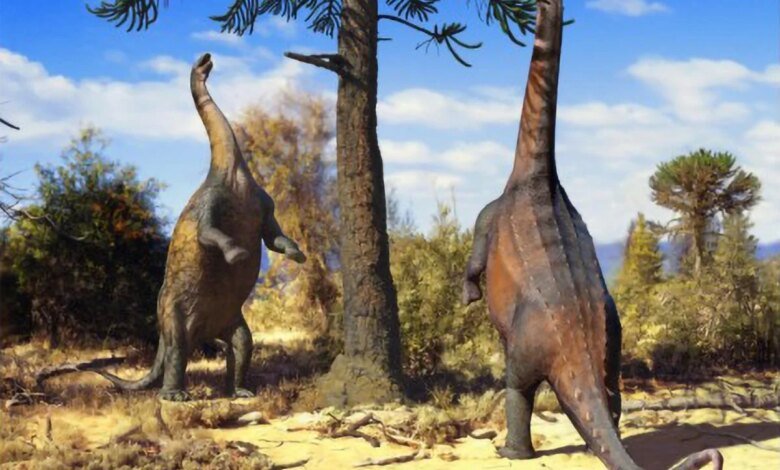
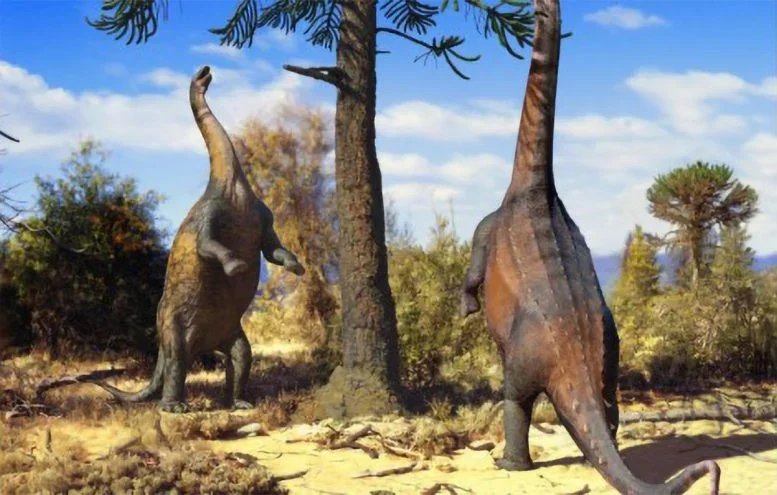
By applying computational engineering methods to model weight and gravitational forces acting on sauropod femurs, researchers found that these massive four-legged dinosaurs were generally able to stay upright while feeding, mating, and defending themselves.
Sixty-six million years ago, two types of long-necked, four-legged dinosaurs had an edge over other sauropods because they could readily rise up and remain standing on their hind legs for long stretches of time. This ability likely helped them deter predators and reach leaves growing high in trees, among other advantages.
The Brazilian Uberabatitan and the Argentine Neuquensaurus were roughly comparable in size to a modern elephant. While they were relatively small members of the sauropod group, adult Uberabatitans are estimated to have grown as long as 26 meters, making them the largest dinosaurs known from Brazil.
to و the و and – تفاصيل مهمة
Because of their enormous size, these animals were probably only able to stay upright for extended periods when they were still young. This finding comes from a study supported by FAPESP and published in the journalPalaeontology. The research team included scientists from Brazil, Germany, and Argentina.
Engineering tools test dinosaur strength
To investigate how these dinosaurs supported their weight, the scientists relied on a computational approach commonly used in engineering. Their goal was to calculate the stress placed on the femur by gravity and body weight when the animals stood on their two hind legs.
“Smaller sauropods like these had a bone and muscle structure that allowed them to stand easily and for longer on their two hind legs. Larger ones were probably also able to stand, but for a shorter time and with less comfort, since the position caused a lot of stress on the femur,” summarizes Julian Silva Júnior, a postdoctoral researcher at the School of Engineering of São Paulo State University (FEIS-UNESP) in Ilha Solteira, Brazil. Silva Júnior is the first author of the study, which was conducted during an internship at the University of Tübingen in Germany with a scholarship from FAPESP.
Digital bones reveal stress patterns
The research team created digital reconstructions of the femurs from seven sauropodspeciesthat represented a range of evolutionary lineages, body sizes, and distinctive anatomical features. These virtual bones were built using fossil specimens housed in natural history museum collections around the world.
the و a و of – تفاصيل مهمة
The simulations relied on finite element analysis (FEA), a computational method used to predict how materials respond to forces and heat. This same technique is commonly applied in fields such as bridge engineering, for example.
“Using this technique, we performed two simulations. One dealt with the extrinsic scenario, simulating the force coming from outside to inside.
In this case, gravity and the animal’s own weight on the femur when the dinosaur was standing on its hind legs. In the other, we analyzed the intrinsic scenario, the force that the muscles would exert on the femur,” Silva Júnior explains.
South American species handled stress best
The combination of the two scenarios suggests the amount of stress each species endured. The two South American sauropods, a juvenile Uberabatitan ribeiroi (named after the Brazilian municipality of Uberaba, where it was found, and coincidentally, Silva Júnior’s hometown) and Neuquensaurus australis (found near the Neuquén River in Argentina), showed the lowest levels of stress on the femurs. Both species lived during the LateCretaceousperiod, about 66 million years ago.
the و on و of – تفاصيل مهمة
“They had robust femurs and could dissipate stress better. The bigger ones had very large muscles and even giant femurs, but not enough to support their weight.
That doesn’t mean they couldn’t stand up, but they probably chose the best time to do so, because it must have been an uncomfortable position,” says the paleontologist. He points out that adult Uberabatitan individuals, unlike the juvenile analyzed in the study, would probably have had the same difficulty standing on their hind legs as other giant species.
This position would have been useful for feeding and reaching food in the highest parts of trees since sauropods were leaf eaters. It may also have been used for reproduction, allowing males to mount females and perform displays to attract mates. Finally, it may have been useful for defense, making them appear larger to potential predators.
Limits of the simulations
The authors note that the simulations did not take into account the cartilage present in these bones, which could dissipate stress quite efficiently. They also did not consider how the tail would support the animals in the tripodal position.
the و have و to – تفاصيل مهمة
Further , since cartilage was not examined in any of the seven specimens, it is assumed that its role was similar in all of them. “The tool we use is very efficient for comparisons, even if the answer isn’t exact for each one. By comparing representatives from different lineages, we can get a fairly accurate picture of how these animals behaved millions of years ago,” says the researcher.
Reference: “Standing giants: a digital biomechanical model for bipedal postures in sauropod dinosaurs” by Julian C. G. Silva Junior, Gabriel S. Ferreira, Agustín G.
Martinelli, Thiago S. Marinho and Felipe C. Montefeltro, 1 August 2025,Palaeontology.
DOI: 10.1111/pala.70019
This work was financed by FAPESP (Fundação de Amparo à Pesquisa do Estado de São Paulo; grant to JCGSJ Process Number 2022/14694-3 and 2024/01597-5), and CNPq (National Council for Scientific and Technological Development; grant to FCM and TSM).
and و for و by – تفاصيل مهمة
Never miss a breakthrough: Join the SciTechDaily newsletter.
Follow us on Google and Google News.
Disclaimer: This news article has been republished exactly as it appeared on its original source, without any modification.
We do not take any responsibility for its content, which remains solely the responsibility of the original publisher.
Author:São Paulo Research Foundation
Published on:2026-01-16 01:02:00
Source: scitechdaily.com
Disclaimer: This news article has been republished exactly as it appeared on its original source, without any modification.
We do not take any responsibility for its content, which remains solely the responsibility of the original publisher.
Author: uaetodaynews
Published on: 2026-01-15 21:32:00
Source: uaetodaynews.com


