
DNA Reveals The Mystery Of The Origins Of The Peoples Of Australia And New Guinea

An international team of researchers led by Professor Helen Farr from the University of Southampton and Professor Martin Richards from Huddersfield has clarified the origins of the first inhabitants of Australia and New Guinea. Work published in Science Advancessheds light on the ancient sea migrations of Homo sapiens and their routes through the Sahul region, which connected modern Australia and New Guinea during the Ice Age.
Place and time of the first settlers
During the last ice age, sea levels were significantly lower, creating a single continent, Sahul. The region was a vast landmass surrounded by shallow straits, allowing people to cross the waters in primitive rafts or boats. Scientists confirm that modern humans arrived hereabout 60,000 years agosupporting the so-called“long chronology”. This refutes alternative versions suggesting a later migration around45 thousand years ago. Travel took place using maritime technology, although the exact routes have long been a matter of debate.
Genetic methods
The team focused on analyzing mitochondrial DNA (mtDNA), which is passed down through the maternal line and can trace the ancestry of women in ancient populations. Using a “molecular clock,” the researchers dated the gene lines by comparing them with known archaeological finds and paleogeographic data.
“This is strong evidence of a long chronology,” said Professor Richards, highlighting the accuracy of the method in estimating when populations separated.
Two migration paths
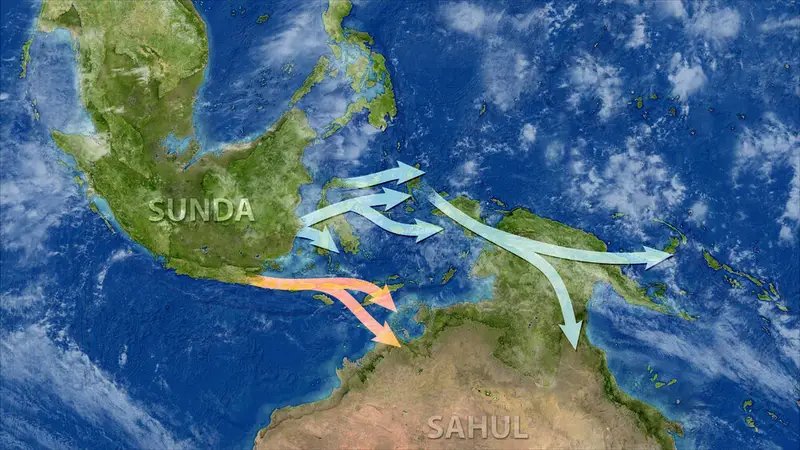
Map showing the migration of the first settlers to Sahul 60,000 years ago.
The results showed that the first settlers reached Sahul by two different routes. The Northern Route ran through northern Indonesia and the Philippines, allowing for the settlement of New Guinea and all of Australia. The southern route originated from southern Indonesia, Malaysia and Indochina and was limited to southern Australia. Both routes date from approximately the same arrival time,about 60,000 years ago, which confirms the simultaneous development of different regions of the continent.
Archaeological evidence
Although DNA is poorly preserved in tropical regions, researchers were able to isolate genetic material from an Iron Age archaeological sample in Indonesia, indicating return migrations from New Guinea. These findings are compared with data from Y chromosome and genome-wide studies, as well as archaeological and environmental evidence. Such a comprehensive check allows us to build accurate models of the early history of the settlement of Sahul.
There was previously a concept of “short chronology”, which suggested that the early settlers were wiped out by subsequent migrations.A new study shows that modern Aboriginal Australians and New Guineans are descended from the first settlers 60,000 years ago.These findings are consistent with archaeological data and climate models of the region, including the influence of the Ice Age on the availability of land and water.
Professor Richards emphasized that further analysis of hundreds of complete human genomes is planned, which will allow the results to be verified and refined based on thousands of lines of inheritance across the entire genome. Professor Farr added:
“It helps understand the maritime mobility and skills of early seafarers, and reflects the rich heritage of the region’s indigenous communities.”
It is expected that new archaeological finds and the extraction of ancient DNA from key remains will allow even detailed reconstruction of the routes and times of migrations.
These discoveries show that Homo sapiens acquired advanced seafaring and navigation skills much earlier than previously thought and were able to cross large bodies of water to establish permanent settlements in new lands. The study strengthens understanding of the connections between genetics, archeology and climate change in human history.
Disclaimer: This news article has been republished exactly as it appeared on its original source, without any modification.
We do not take any responsibility for its content, which remains solely the responsibility of the original publisher.
Disclaimer: This news article has been republished exactly as it appeared on its original source, without any modification.
We do not take any responsibility for its content, which remains solely the responsibility of the original publisher.
Author: uaetodaynews
Published on: 2025-12-26 08:25:00
Source: uaetodaynews.com