
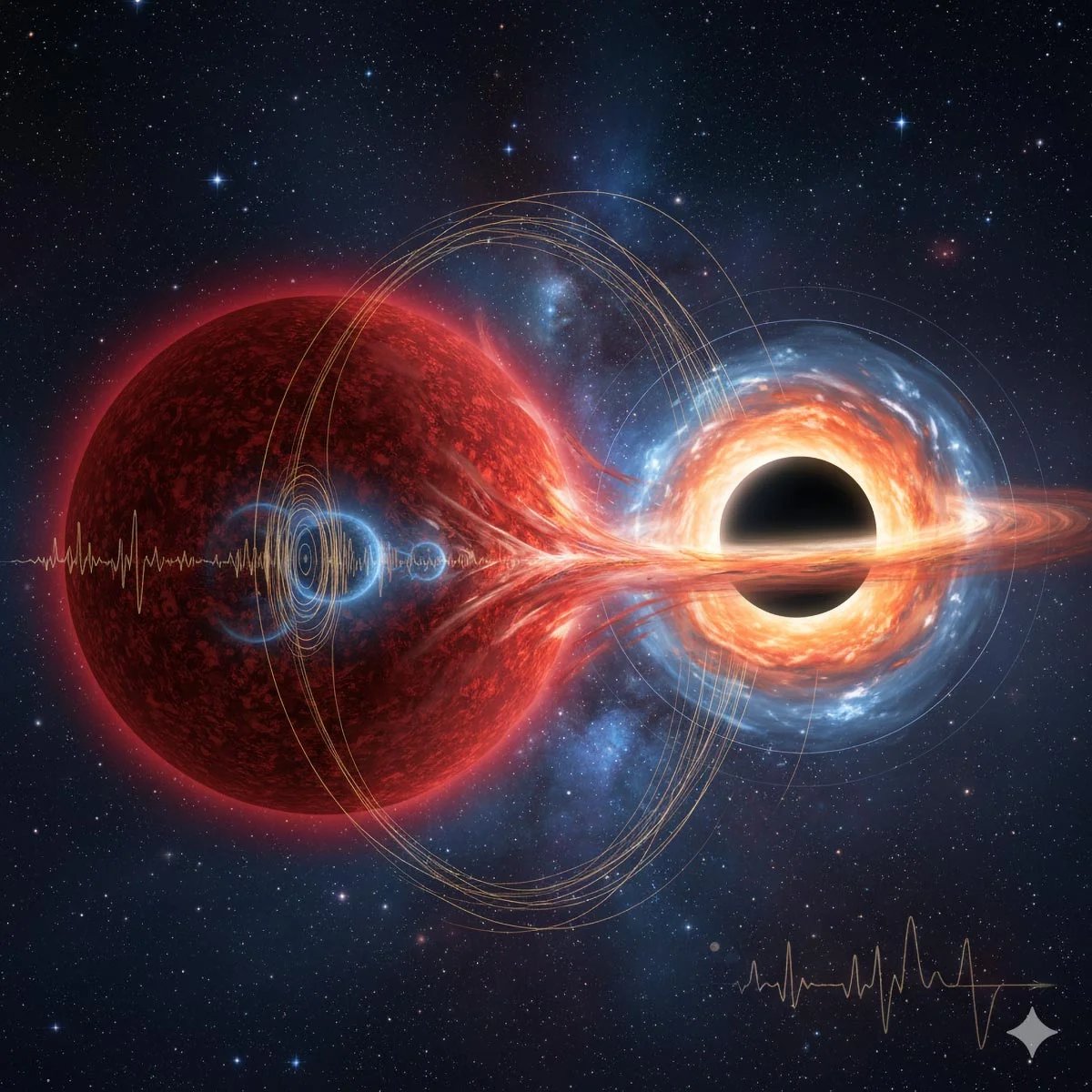


Astronomers have uncovered clues to a red giant’s chaotic past by detecting subtle stellar vibrations that hint at a long-ago collision and an unexpectedly rapid spin.
Astronomers at the University of Hawaiʻi Institute for Astronomy (IfA) have pieced together the turbulent history of a distant red giant by studying the rhythms hidden in its light. Slight shifts in the star’s brightness indicate it may have collided and merged with another star in the past, a dramatic event that left it rotating unusually fast. Today, this star orbits a dormantblack holein the Gaia BH2 system.
With observations fromNASA’s Transiting Exoplanet Survey Satellite (TESS), IfA researchers identified faint “starquakes” moving through the Gaia BH2 companion star, which was recognized as a black hole system by theEuropean Space Agency’s Gaia mission in 2023. Similar to how seismic activity reveals Earth’s interior, these vibrations offered an uncommon look inside the star and allowed scientists to determine its core characteristics with exceptionalaccuracy. The research has been published inThe Astronomical Journal.
“Just like seismologists use earthquakes to study Earth’s interior, we can use stellar oscillations to understand what’s happening inside distant stars,” said IfA research scientist Daniel Hey, lead author of the study. “These vibrations told us something unexpected about this star’s history.”
Age-defying star
The most unexpected finding came from the star’s composition. It is classified as “alpha-rich”, indicating that it contains an abundance of heavier elements typically seen in stars that formed long ago, which would normally imply great age. Yet when researchers analyzed its vibrations, they determined that the star is only about 5 billion years old, far too young to naturally possess these chemical characteristics.
Audio of star vibration. Credit: UH Institute for Astronomy
“Young, alpha-rich stars are quite rare and puzzling,” explained Hey. “The combination of youth and ancient chemistry suggests this star didn’t evolve in isolation. It likely acquired extra mass from a companion, either through a merger or by absorbing material when the black hole formed.”
Faster than expected
The mystery deepens with long-term observations from ground-based telescopes showing the star rotates once every 398 days, much faster than expected for an isolated red giant of its age.
“If this rotation is real, it can’t be explained by the star’s birth spin alone,” said co-author Joel Ong, a NASA Hubble Fellow at IfA. “The star must have been spun up through tidal interactions with its companion, which further supports the idea that this system has a complex history.”
The team also examined Gaia BH3, another black hole system with an even unusual companion star. Although models predicted that this star should show clear oscillations, none were detected, hinting that current theories about extremely metal-poor stars may need updating.
Both Gaia BH2 and BH3 are dormant black hole systems, meaning they aren’t feeding on their companion stars and therefore emit no X-rays. Their discovery through precise measurements of stellar motion is reshaping how astronomers understand black holes in our galaxy.
Peering deeper ahead
Future TESS observations of Gaia BH2 will give scientists a closer look at its stellar vibrations and may confirm whether it formed through a past merger, helping unravel how these quiet black hole pairs came to be.
Reference: “Asteroseismology of the Red Giant Companions to Gaia BH2 and BH3” by Daniel Hey, Yaguang Li and J. M. Joel Ong, 13 November 2025,The Astronomical Journal.
DOI: 10.3847/1538-3881/ae0e25
Never miss a breakthrough: Join the SciTechDaily newsletter.
Follow us on Google and Google News.
Disclaimer: This news article has been republished exactly as it appeared on its original source, without any modification.
We do not take any responsibility for its content, which remains solely the responsibility of the original publisher.
Author:University of Hawaiʻi Institute for Astronomy
Published on:2025-11-26 21:44:00
Source: scitechdaily.com
Disclaimer: This news article has been republished exactly as it appeared on its original source, without any modification.
We do not take any responsibility for its content, which remains solely the responsibility of the original publisher.
Author: uaetodaynews
Published on: 2025-11-26 18:02:00
Source: uaetodaynews.com