
Prepared by the Editorial Team
Fiber-optic cables are no longer merely a means of transmitting data and communications at high speeds. Scientific research is expanding their use as a network of sensors capable of detecting vibrations and physical changes along long routes.
Among the applications drawing interest from researchers and information security professionals is the possibility of using this technology to capture acoustic vibrations associated with human speech.
The significance of this development lies in the fact that infrastructure used to transmit internet traffic can, under specific technical conditions, provide sensory data about the environment surrounding the cables, opening a new discussion about privacy and the protection of communications networks.
But one essential point needs to be made clear: this does not mean that any ordinary internet cable can record conversations in people’s homes or automatically read communications.

Optical acoustic sensing test setup: DAS system and signal analysis equipment.
How do fiber-optic cables become sensors?
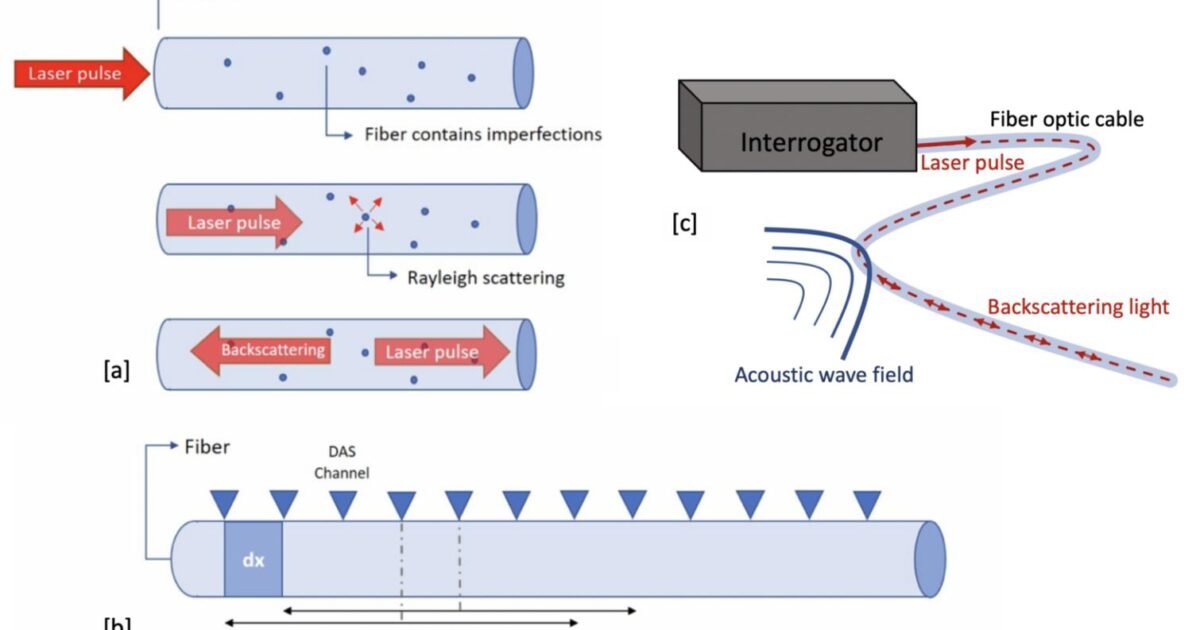
The technology known as Distributed Acoustic Sensing, or DAS, relies on a specialized device called an optical interrogator.
The device sends laser pulses into the fiber-optic cable, then receives the returning light produced by Rayleigh scattering, a phenomenon caused by natural microscopic inhomogeneities in the optical material.
When a cable is exposed to vibration or mechanical change, the properties of the returning optical signal change. These changes can be analyzed to extract information about the strain or vibration to which the cable was subjected.
In this way, the cable does not function as a conventional microphone. Instead, it serves as a medium through which physical changes transmitted to it can be measured.
The technology’s strength lies in its ability to distribute measurement points over long distances, rather than requiring a separate sensor to be installed at each point.
The technology has been used in research on earthquakes and ground vibrations, as well as in monitoring structures and infrastructure.
New scientific study tests the possibility of capturing speech
In a study published in 2026 in the journal Optics Communications, titled:
Possibilities and Limitations of Speech Acoustic Sensing Using Fiber Optics: Comparison of Interferometric and Distributed Approaches
researchers tested the possibility of capturing human speech using standard fiber-optic communications cables in realistic setups.
The study compared three technical approaches:
- Michelson Interferometer.
- Distributed acoustic sensing using a single pulse.
- Distributed acoustic sensing using two pulses and phase-difference measurement.
The researchers relied on a set of scientific metrics to assess signal quality, speech intelligibility, and the possibility of recovering its acoustic structure.
The most significant finding was that the tested systems could detect the presence of speech and identify its temporal structure, but could not reliably reconstruct intelligible speech under real-world conditions.
The Michelson approach recorded the best speech-quality indicators among the methods compared, while the dual-pulse DAS mode outperformed the single-pulse mode in sensitivity and signal-to-noise ratio.
This means that the physical possibility of capturing traces of speech exists, but turning them into clear, intelligible conversation remains limited.
Why can’t a cable transmit a conversation directly to an attacker?
There is a fundamental difference between intercepting digital data and eavesdropping on sound through vibrations.
In the first case, an attacker attempts to access data transmitted over the network, such as internet packets, call records, or encrypted data.
In the second, the attacker attempts to measure the mechanical changes in the cable caused by surrounding vibrations.
Detecting a vibration does not mean that the audio content can be recovered.
Signal quality is affected by several factors, including:
- The cable’s construction and fiber characteristics.
- How the cable is secured and the route along which it is laid.
- How much vibration is transmitted from the surrounding environment to the cable.
- The distance between the sound source and the cable.
- The intensity of noise and mechanical interference.
- The sensitivity and settings of the interrogator.
- Signal-processing and speech-reconstruction algorithms.
Therefore, the presence of a fiber-optic network in a building or street does not mean that conversations taking place nearby are automatically exposed.
From eavesdropping to infrastructure monitoring
Al though recovering intelligible speech under real-world conditions remains limited, the technology’s potential applications are not restricted to human speech.
Fiber-optic networks can be used to detect ground vibrations and earthquakes, monitor certain physical activities along communications lines, and analyze events that affect infrastructure.
This capability gives network operators and researchers an additional way to understand what is happening around cables, without having to deploy thousands of conventional sensors.
At the same time, any use of this technology to collect data about people or places raises questions about consent, privacy, data retention, and which parties are entitled to access it.
What does this mean for communications security?
These developments require communications network operators to consider protecting the network’s physical infrastructure, not just its communication protocols and software systems.
It is important to distinguish between protecting transmitted data and protecting cables and sites that could be subjected to physical measurement or tampering.
Security policies should also include an assessment of the risks of unauthorized access to infrastructure, the devices that could be connected to it, and the data generated by sensing systems.
Conclusion: The internet is not becoming an all-purpose microphone
The scientific study shows that fiber-optic cables can become an advanced sensing platform, but it does not prove that current internet networks can record everyday conversations clearly or automatically.
The difference between detecting the presence of speech and recovering its content is a fundamental technical distinction that should not be overlooked.
Nevertheless, the development of DAS systems adds a new dimension to the future of communications security: protecting a network is no longer limited to the data that passes through it, but also extends to the physical signals that can be extracted from its infrastructure.
Scientific sources:
- Ondřej Mokrý et al., Optics Communications, Volume 608, 2026.
- Brno University of Technology, Faculty of Information Technology.
- European Geosciences Union, explanation of Distributed Acoustic Sensing technology.
Original study: DOI: 10.1016/j.optcom.2026.132987.