
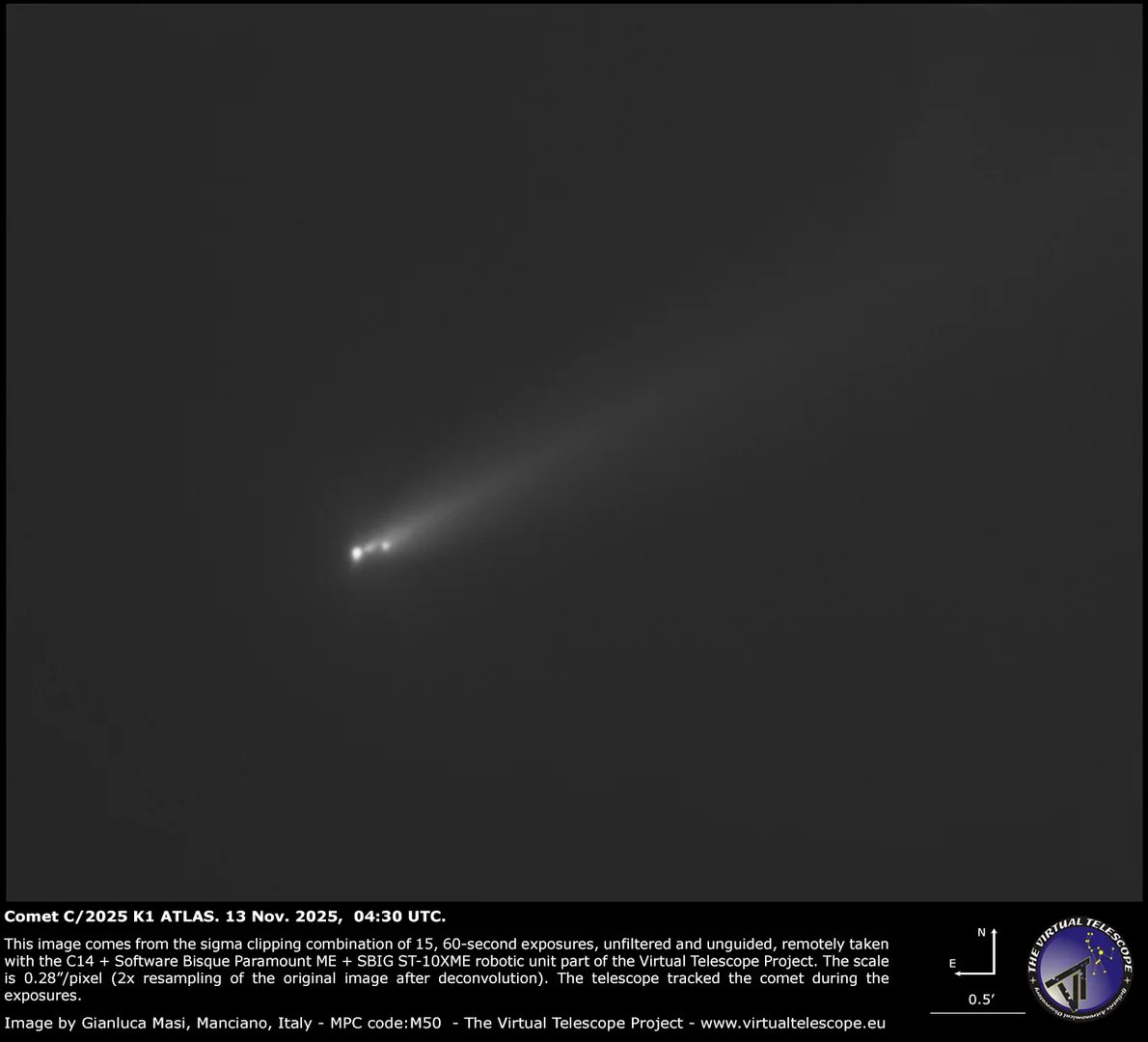


Comet C/2025 K1 (ATLAS) has shone noticeably since its discovery in May 2025. As it approached the sun and its temperature increased, the frozen gases in its core turned into a gaseous state, forming a reflective cloud around it known as the “coma.” The solar wind then pushed this gas behind it, forming the distinctive tail of comets.
The comet’s luminosity did not reach the point where astronomers could see it with the naked eye. However, its close proximity to the sun on October 8 caused a defect in its structural formation, threatening its existence, which dates back billions of years.
🚨 K1 ATLAS Just Broke Apart — A Once-in-a-Lifetime Cosmic Event You Can’t Miss 💥
On 13 November 2025, astronomers captured something rare and amazing: Comet C/2025 K1 ATLAS has broken into pieces. At first, it looked like a huge cosmic explosion. But this is not the famous… pic.twitter.com/Q6ll8YTf2w
— Astronomy Vibes (@AstronomyVibes)🚨 K1 ATLAS Just Broke Apart — A Once-in-a-Lifetime Cosmic Event You Can’t Miss 💥
On 13 November 2025, astronomers captured something rare and amazing: Comet C/2025 K1 ATLAS has broken into pieces. At first, it looked like a huge cosmic explosion. But this is not the famous…pic.twitter.com/Q6ll8YTf2w
— Astronomy Vibes (@AstronomyVibes)November 14, 2025
Fortunately, Astronomers were able to observe the dramatic disintegration process on November 11-12 Using the 1.82 meter Copernicus telescope at the Asiaco Observatory in Italy.
And revealed Telescopic observations The comet split into three large parts by the night of November 11. Astronomer Mazzotta Epifani wrote in a statement published on the website of the Italian National Institute of Astrophysics: “Through preliminary analysis of the images, we can confirm the presence of two very similar pieces, separated by a distance of about 2,000 km.” She added: “We also suspect the presence of a third piece, smaller in size and dimmer in shine, located to the left of the two pieces.”
As for astronomer Gianluca Massi from the Virtual Telescope Project, he in turn captured amazing scenes of the disintegration on the nights of November 12-13, as a large section of the nucleus appeared to move away from the part facing the sun.
Comet C/2025 K1 (ATLAS) is believed to have originated in the distant Kuiper Belt, and may have disintegrated during its first journey into the inner solar system. Thus, this comet represents a pure time capsule, the composition of which may shed light on the formation of the planetary nebula from which the planets we know today arose.
It is important to clarify that this comet is not related to the interstellar comet 3I/ATLAS, which recently made headlines, but rather they share the discovery system (ATLAS).
Source: Space
Disclaimer: This news article has been republished exactly as it appeared on its original source, without any modification. We do not take any responsibility for its content, which remains solely the responsibility of the original publisher.
Author:
Published on:2025-11-14 15:38:00
Source: arabic.rt.com
UAETodayNews delivers the latest news and updates from the UAE, Arab world, and beyond. Covering politics, business, sports, technology, and culture with trusted reporting.
Disclaimer: This news article has been republished exactly as it appeared on its original source, without any modification. We do not take any responsibility for its content, which remains solely the responsibility of the original publisher.
Author: uaetodaynews
Published on: 2025-11-17 06:37:00
Source: uaetodaynews.com